


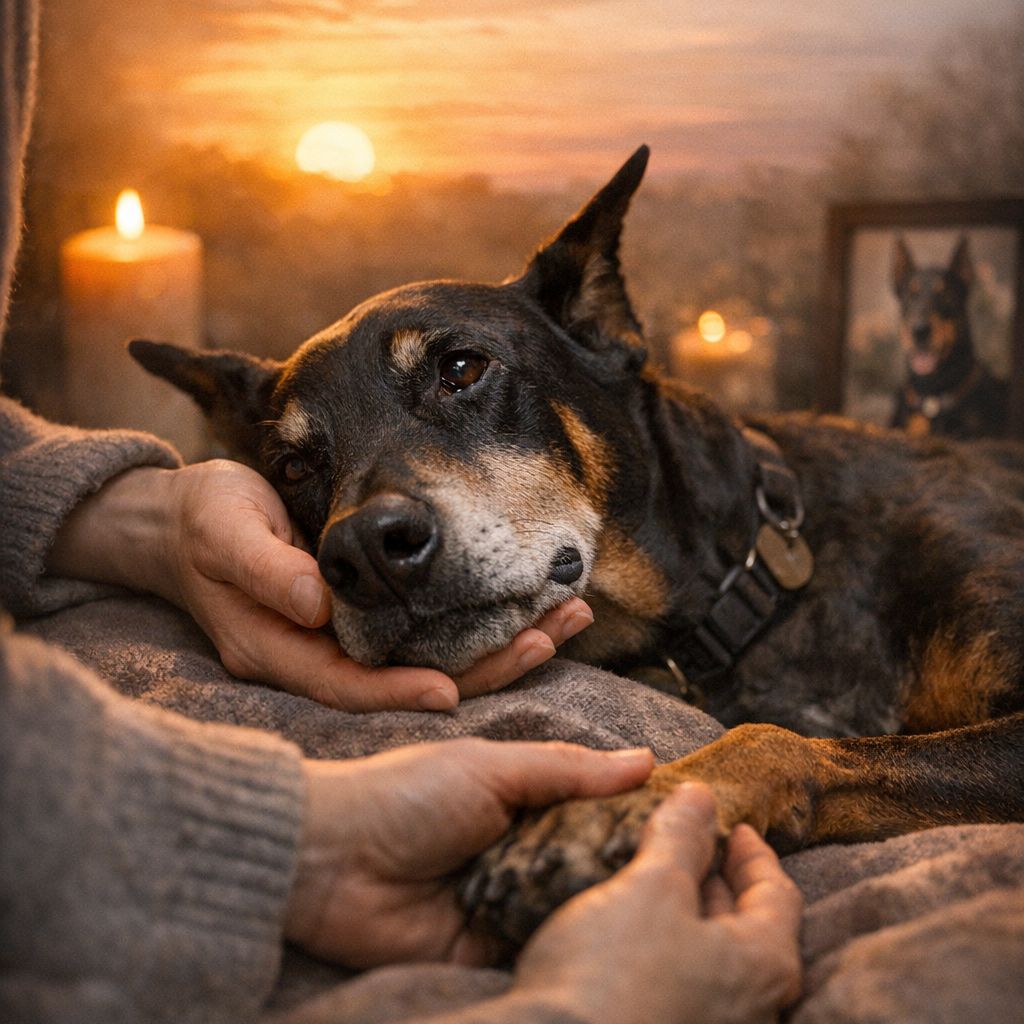
Dear friends,
We are writing to you from that silence known to everyone who has loved a dog long enough. A silence where love and pain meet, where responsibility and doubt intertwine. For many of us, there comes a moment when we must answer the question no one ever wants to ask: when is it time to say goodbye?
Perhaps you are already feeling the weight of that decision on your shoulders. Perhaps you fear the day when you will have to make it. Or maybe you are searching for comfort after already crossing that abyss of pain. Wherever you are on this journey, you are not alone. Many of us have walked this path before you, each carrying our own unique story, yet all connected by the same essential love for a being who gave us unconditional loyalty and a love beyond comparison.
Doubt, hope, guilt, sadness, anger, helplessness, fear, pain, all of it, mixed together… and us, pulled into a vortex of unrest. Does it sound familiar?
When the Words We Want to Say Are Impossible
Recently, we gathered for a pleasant dinner in a restaurant people from the world of Doberman breeding before one of the major competitions in this region. Conversations flowed easily, mostly about dogs, future pairings, old times, and well-known champions.
During that evening, I met a wonderful girl from Croatia. We started talking about dogs, and very quickly I realized how deeply she loved the Doberman breed. She wasn’t a breeder she had one dog. A beautiful, elegant female of the old European Doberman type, whom she decided to put to sleep at the age of 11.
She told me something that stayed with me:
“When she was a puppy, I promised her nothing will ever hurt you, you will never suffer… That day, we went to the vet, and it was as if she knew. She walked into the examination room on her own and lay down in a place she had never chosen before. I told her, I know it’s time. She walked in on her own legs, and that’s how I want to remember her. My veterinarian sat next to us and cried for an hour he had cared for her for 11 years. She was in a terrible condition.”
I remember thinking how much courage love requires. The courage to endure vulnerability, guilt, even when we know we are doing the best we can.
I remember the moment I looked into the eyes of my old dog, Vortex, and saw that his essence was slowly fading into the fog of pain. He was with me for eleven years. Full of energy, full of strength no ball ever survived him. He was always first at the door, and the last one outside when it rained.
He would lie lazily in the sun on the balcony, lifting his head from time to time just to see where I was and what I was doing. He was there in the way only a dog can be quietly carrying all the secrets and burdens of my life within his soul.
And now, illness had filled his world with suffering he could no longer bear.
Our beloved dogs do not speak our language, but they speak in a language we learn to understand through years of living together. Sometimes, in their quiet way, they tell us that the burden of life has become too heavy.
In those moments, we sometimes need something to help us see more clearly, beyond the pain clouding our judgment. This is where we must face a difficult truth – what veterinary expert Dr. Alice Villalobos calls a “quality of life assessment.”
According to her well-known HHHHHMM protocol (Hurt, Hunger, Hydration, Hygiene, Happiness, Mobility, More good days than bad), we must ask ourselves difficult but necessary questions:
Is my dog in pain that cannot be adequately controlled?
Can they eat with enjoyment and maintain body weight?
Are they dehydrated or able to take in enough fluids?
Can they maintain basic hygiene or are they suffering due to loss of bodily control?
Do they show signs of happiness and engagement with family?
Can they move with reasonable comfort?
Do they have more good days than bad?
These questions don’t give simple yes/no answers – they guide us through understanding the overall quality of our pet’s life.
The Path We Don’t Want to Recognize
As Vortex aged, his steps became unsteady, his appetite inconsistent. At first, the changes were barely noticeable. A little more sleep. Less enthusiasm for play.
Then gradually, they became impossible to ignore.
He stopped greeting visitors. Food he once loved remained untouched. Nights were filled with restlessness and quiet whining. So many sleepless nights, holding him, hoping to comfort him, trying to understand what was happening.
Each of us senses it first quietly… and then as a growing fear that doesn’t let go.
Statistics say that around 50% of dogs over 10 develop some form of cancer. About 90% of pet owners will face the decision of euthanasia at some point.
These are just numbers cold and precise. They say nothing about the emotional storm behind each case.
When Hope Becomes a Burden
Hope. A word that comforts – but can also become the heaviest burden.
“I’ll try one more infusion…”
“Maybe the new medication…”
“Let’s try vitamins…”
“Maybe surgery…”
And yes—sometimes miracles do happen.
But we must be careful that our hope does not become selfish, that it does not prolong suffering because we are not ready to let go.
There is a thin line between hope and denial. And beyond that line is not love, but preventable suffering.
As veterinarian Dr. Dani McVety said:
“It’s better to let your pet go one day too early than one day too late.”
Harsh words but deeply true.
What Does the Process Look Like?
Modern euthanasia is designed to be peaceful, painless, and dignified.
It happens in two steps:
1. A sedative is given, allowing the pet to fall into a deep, calm sleep.
2. An anesthetic overdose gently stops the heart.
The animal feels no pain.
I held Vortex’s head in my lap. I felt his breathing slow. His body, tense from weeks of pain, finally relaxed.
That moment of peace on his face… is what I hold onto.
The Other Side: Aggression
There is also another kind of euthanasia one we rarely speak about aggressive dogs.
Some dogs, despite all training and care, become dangerous.
This decision carries a different kind of pain guilt, questions, “what ifs.”
But sometimes, despite everything, we cannot change genetics or neurological realities.
After the Decision
How do you live with the silence?
Grief for a pet is real. Deep. Often unrecognized.
But your grief is valid.
Studies show it can be as intense as losing a human family member.
There is no shortcut through grief. The only way is through it.
The Hardest Truth
Months after Vortex was gone, I questioned everything.
Was it too soon?
Did I do enough?
But doubt is also a form of love.
We question because we care.
And sometimes, we must be gentle with ourselves and accept:
we did the best we could.
The Final Gift
Our pets live in the present.
They don’t fear death.
They only know comfort or pain, love or suffering.
Euthanasia literally means “a good death.”
And perhaps that is the final gift we can give:
freedom from pain,
a peaceful passing,
surrounded by love.
If you are standing before that hardest decision, remember:
Sometimes saying goodbye is the bravest and most loving act of all.
Your pain is proof of how deeply you loved.
Hold them. Kiss them.
Let the last thing they see and smell be you.
And those eyes you look into
that love in them – it never dies.
With deep understanding,
Someone who has loved and lost.